How to Read Your Five-Page Birth Chart PDF
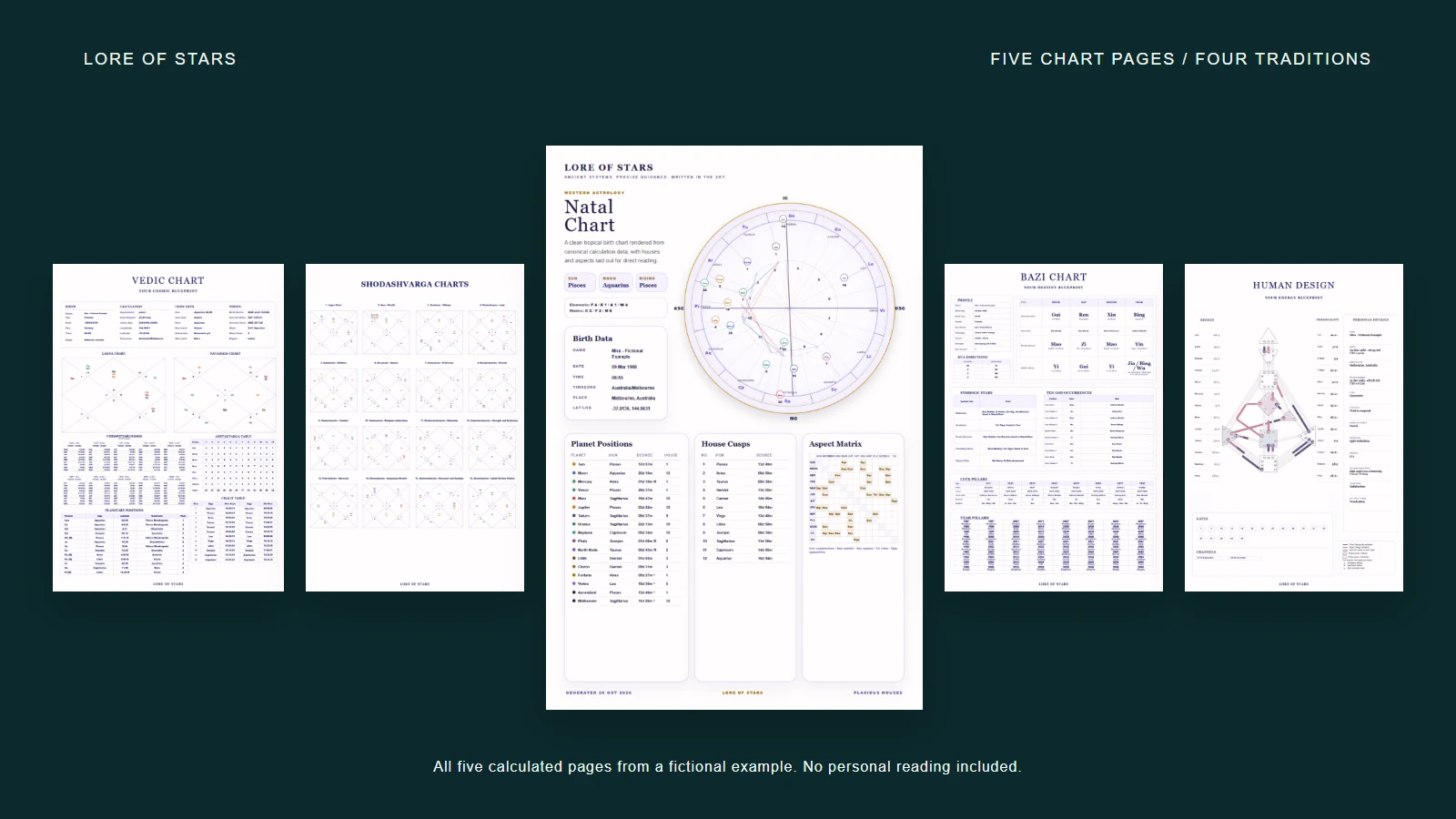
Five pages do not mean five different versions of you. Find the useful labels on each chart, keep the four traditions separate, and know where to start.
The free Lore of Stars PDF contains five pages: Western astrology, Vedic astrology, a Vedic divisional-chart reference, BaZi, and Human Design. That is four traditions, not five. You do not need to understand every symbol to begin. Check your birth details, find the main labels, and read one page at a time.
This guide uses a calculated fictional example called Mira, not a customer's chart. The five pages were made locally with the same chart renderer used by the free service, with timing information referenced to 20 October 2026. Their placements are examples, not your results. The free file provides charts, tables and brief system labels; it is not a chapter-by-chapter personal reading.
Before reading: check the details at the top
Look at the birth date, local clock time and birthplace first. A good-looking diagram can still describe the wrong inputs. Pay particular attention to AM versus PM and the selected city. The time zone belongs to the place and historical date; it is not simply the time zone where you live now.
If your recorded time is uncertain, do not invent one to make a preferred result appear. Read the birth-time guide before ordering an exact-time report. You can use this walkthrough to learn the page labels without treating an uncertain chart as settled.
Page 1: Western astrology - start with three labels
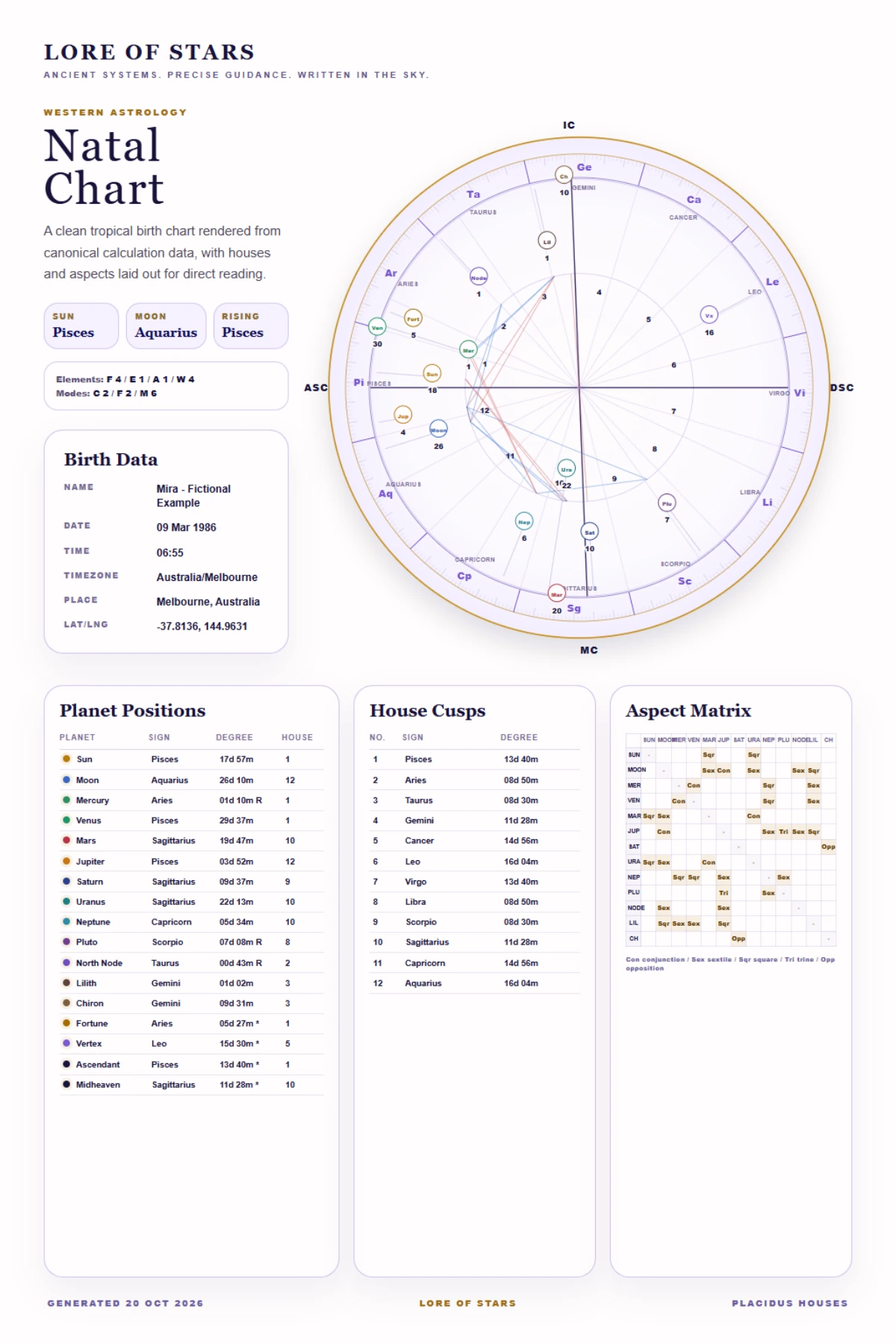
Find Sun, Moon and Rising in the upper-left summary. Rising is another name for the Ascendant, the zodiac point rising on the eastern horizon at birth. In Mira's example these labels are Pisces Sun, Aquarius Moon and Pisces Rising. That is a starting orientation inside Western astrology, not three sentences that explain the whole person.
Next, find the Sun in the Planet Positions table. Read across its sign, degree and house, then locate it on the wheel. A degree is a position within a sign; a house is a division associated with a life area. The lines in the wheel and the Aspect Matrix describe angular relationships between positions. Start by matching labels rather than trying to read every line as a separate prediction.
Page 2: Vedic astrology - keep its settings visible
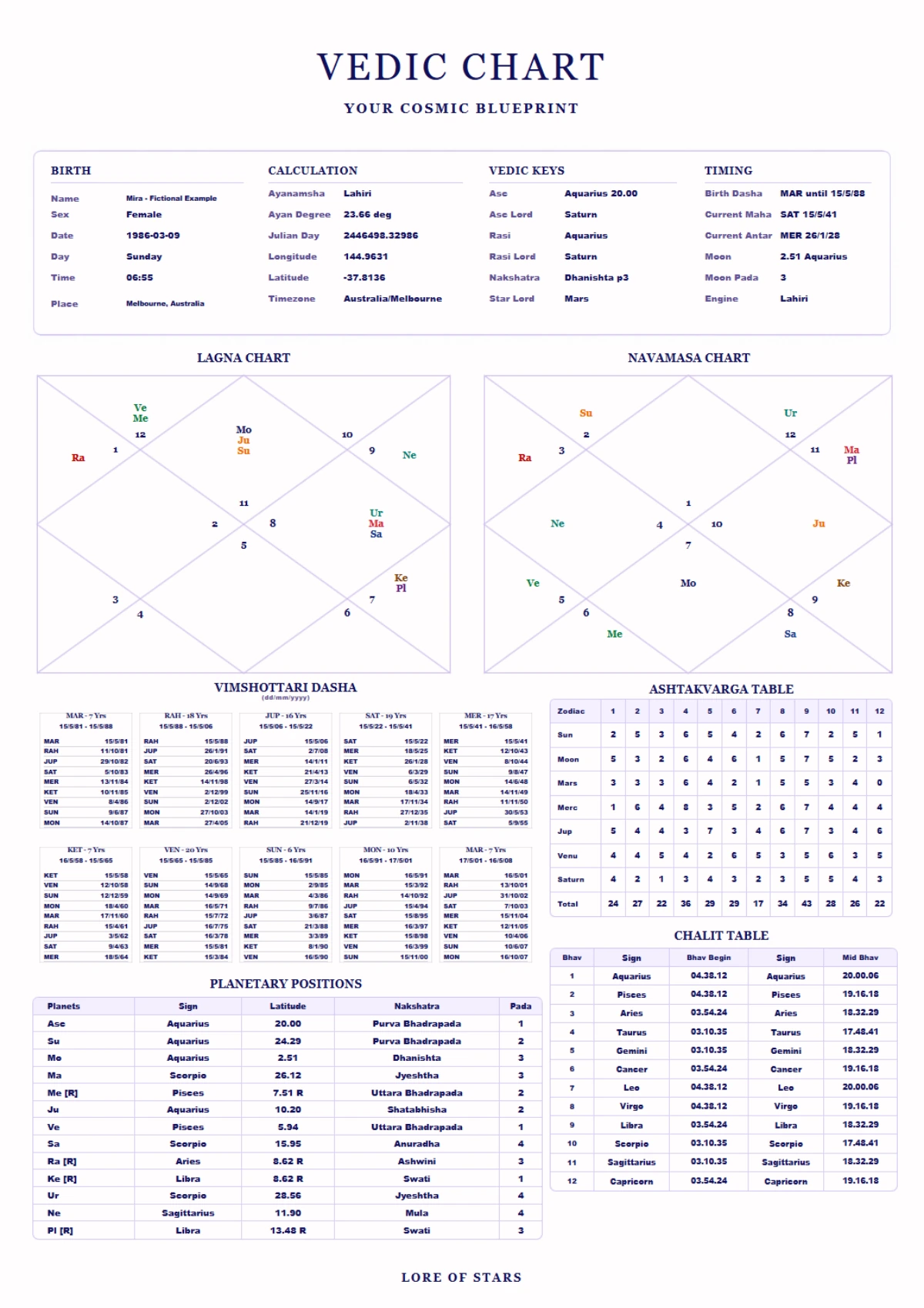
The calculation panel names Lahiri, the sidereal reference used here. The Western page uses a tropical zodiac. In this fictional example, the Sun is Pisces on the Western page and Aquarius on the Vedic page. The Moon is Aquarius on both. This is why moving every Western placement back one sign is not a reliable shortcut. Read why Western and Vedic signs differ if the change is surprising.
On this North Indian-style page, the numbers inside the diagrams identify zodiac signs; do not assume every printed number is a house number. Use the Lagna chart and the labeled planetary table together. The Vimshottari Dasha section is a traditional schedule of planetary periods, not a list of events that must happen. Some periods began before birth because the chart shows the larger period containing the birthday. Dates use day/month/year order, with shortened years in some cells.
Page 3: Shodashvarga - a reference, not another tradition
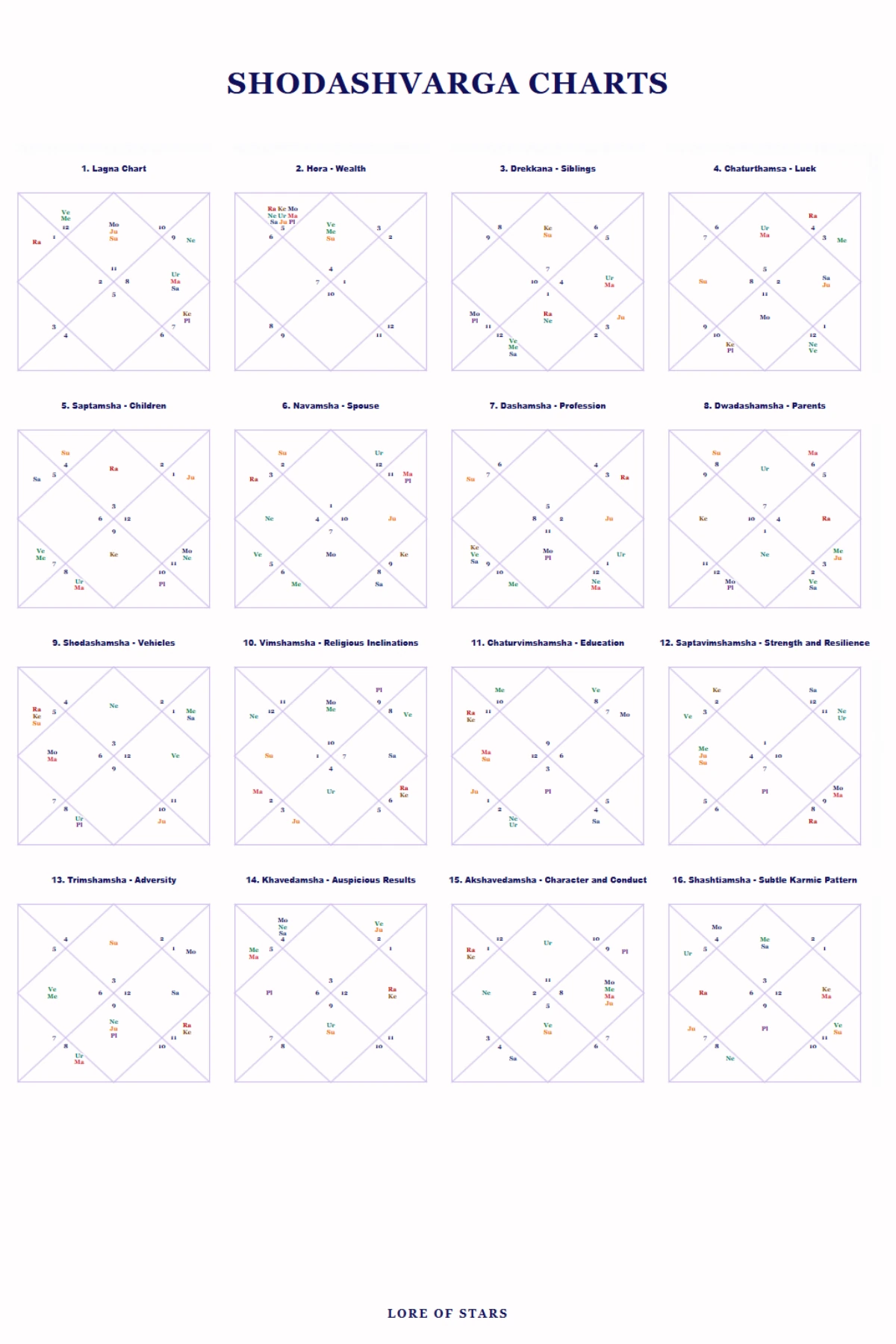
Shodashvarga means a set of sixteen divisional charts within Vedic astrology. The page uses names such as Lagna, Hora and Navamsha. Lagna is the main D1 reference; Navamsha is commonly called D9. These are different calculations within the Vedic framework, not sixteen independent birth charts or sixteen unrelated forecasts.
For a first read, recognize the page and its labels, then return to the main Vedic page. Do not choose one small diagram and use it alone to decide your career or relationship future. Divisional interpretation needs its own method and context; the printed life-area labels are headings, not conclusions about you.
Page 4: BaZi - find the Day pillar
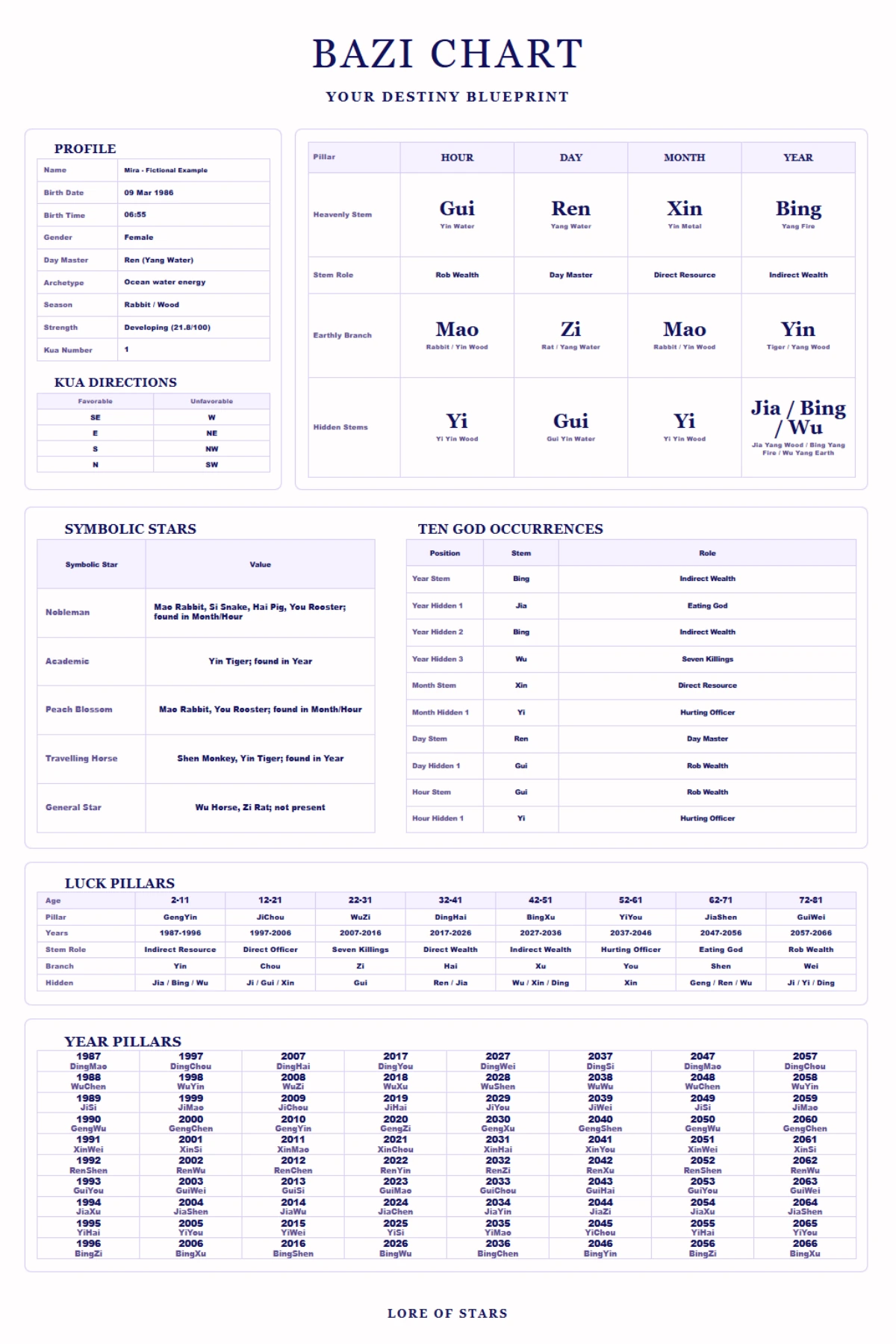
BaZi arranges the birth year, month, day and hour into four pillars, each with an upper stem and a lower branch. This page orders its columns Hour, Day, Month, Year, so follow the headings rather than assuming a left-to-right calendar sequence. In the Day column, the upper stem is the Day Master. Mira's example labels it Ren, or Yang Water.
The Day Master is the reference used to relate the other elements and roles; it is not your Chinese year animal. Names such as Rob Wealth and Seven Killings are traditional relationship labels, not literal predictions of theft or violence. The Luck Pillars table is another timing layer. Its age bands and dates belong to this example, not everyone born in the same animal year. For the basic distinction, read Chinese zodiac versus BaZi.
Page 5: Human Design - read the summary before the network
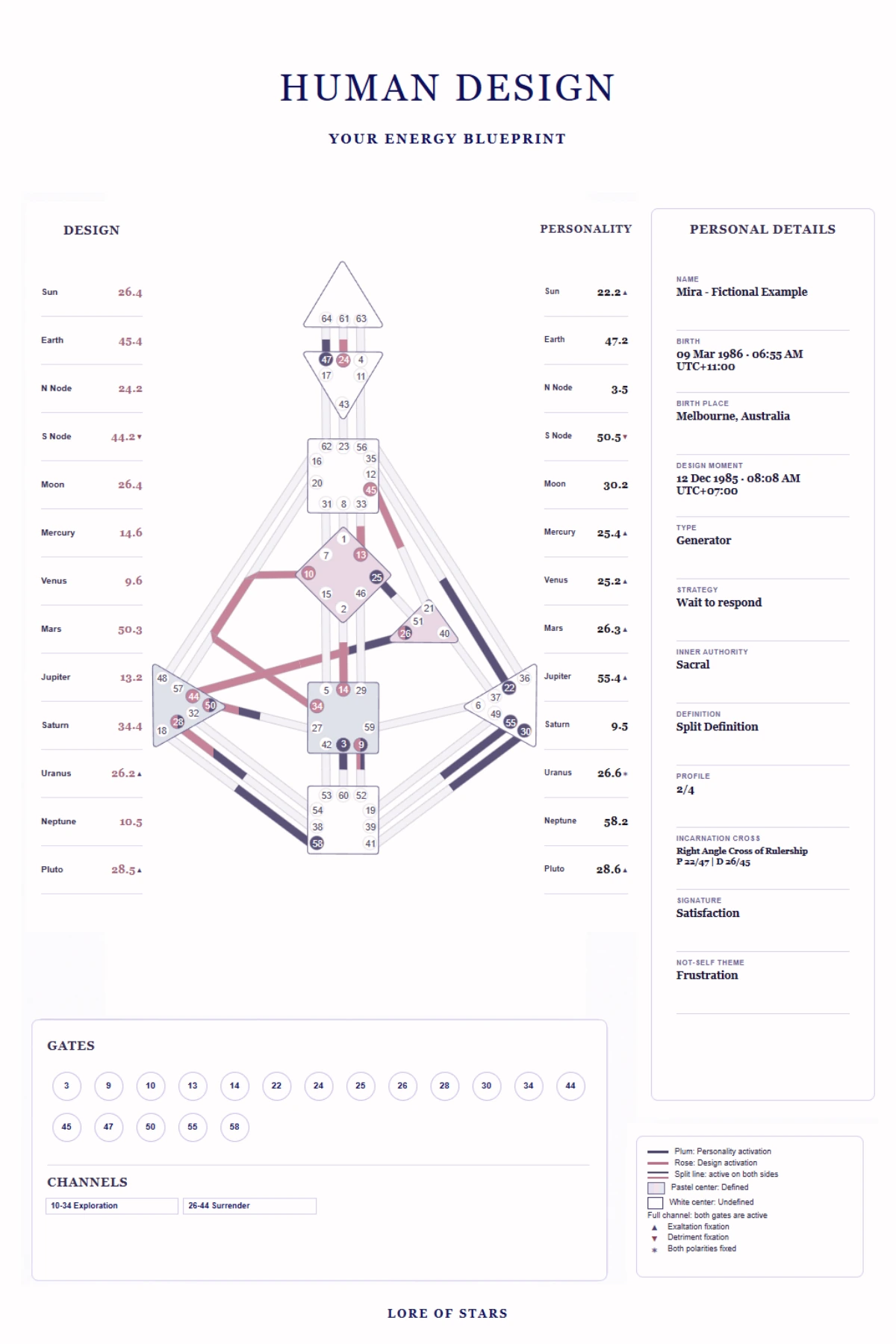
Begin with Type, Strategy and Inner Authority in Personal Details. These are Human Design terms, not Western signs or BaZi elements. Mira's example says Generator, Wait to respond, and Sacral authority. The central BodyGraph, numbered gates and connecting channels are the technical reference behind those labels.
You do not have to decode the entire diagram in one sitting. Start with the beginner's guide to Human Design authority, then return to the labels on your own page. A defined or undefined center is terminology within this system, not a measure of your worth or a medical finding.
A useful first pass takes one small step
Check the inputs. Identify the tradition on each page. Write down one label you understand and one question you want answered. You now have a way into the PDF without forcing all four methods into one vocabulary. Calculating a position and interpreting its meaning are different tasks, and these traditions do not establish a guaranteed personal outcome.
Create your free five-page chart PDF. It is delivered by email without an account or a purchase. Start with the diagrams; you can decide separately whether you want a longer written interpretation.
Sources
- Swiss Ephemeris: zodiac references, positions and house calculations
- Joey Yap: the four pillars and Day Master
- Jovian Archive: beginner Type, Strategy and Authority terminology
- Lore of Stars: calculation methods and system boundaries
Continue reading
- Saturn Return vs Sade Sati: What Is the Difference?
- What a Personalized Birth Chart Report Includes
- Vedic vs Western Astrology: Why Your Signs Are Different
Get the weekly Almanac email - two useful reads, no daily noise.